Time Blocking for ADHD: Complete Visual Scheduling Guide
Time blocking for ADHD works best with short, color-coded blocks, buffer time between them and a timer that makes each block visible. Plan three to five focus blocks a day instead of scheduling every hour, put your hardest task where your energy peaks, and leave 5 to 15 minutes of buffer after each block, because tasks usually run long.
Start with 25 minute blocks (use our free visual timer), then stretch to 45 minutes for deep work once the habit sticks.
Updated 2026. Researched from published sources; general information, not medical advice. If you are struggling, talk to a doctor or licensed therapist.
| Block | Length | Use it for |
|---|---|---|
| Focus block | 25 minutes | Most tasks, getting started |
| Deep work block | 45 minutes | Hard tasks at peak energy |
| Admin block | 15 minutes | Email, calls, quick tasks |
| Buffer | 5 to 15 minutes | Overruns and transitions |
| Maximum stretch | About 90 minutes | Then take a real break |
Starting points, not rules; adjust to your own energy.
The ADHD Time Paradox: You either have no sense of time or become obsessed with every minute. Time blocking solves this by making time visual, concrete, and manageable. This is how you turn abstract time into something your ADHD brain can actually work with.
🧠 Why Traditional Scheduling Fails ADHD Brains
Standard scheduling assumes you can estimate time accurately and stick to abstract plans. ADHD brains have different needs:
- Time Blindness: Can't accurately estimate how long tasks take
- Visual Processing: Need to see time, not just think about it
- Hyperfocus Risk: Can work for 6 hours without noticing
- Transition Difficulty: Hard to switch between different types of activities
- Energy Fluctuations: Peak performance varies throughout the day
- Dopamine Seeking: Need immediate rewards and clear progress
Time blocking addresses all these challenges by creating visual, structured, and flexible time management.
As an Amazon Associate, we earn from qualifying purchases. Product picks are researched suggestions, not medical or professional advice.
Time Blocking Tools for ADHD
- Time Timer MOD - Visual Timer Perfect for time blocking - see exactly how much time remains in each block
- ADHD Daily Planner - Time Block Layout Physical planner designed with visual time blocks for ADHD brains
- Cube Timer - Multi-Duration Timer Flip to instantly set different time block durations (5, 15, 25, 45 min)
🎨 ADHD-Friendly Time Blocking Principles
🌈 The Color-Coded Brain Method
ADHD brains process colors faster than text. Use color coding to make your schedule instantly understandable:
- 🔴 Deep Focus (Red): High-concentration work, important projects
- 🟢 Admin/Easy (Green): Email, calls, routine tasks
- 🟡 Creative (Yellow): Brainstorming, writing, design work
- 🔵 Learning (Blue): Reading, courses, skill development
- 🟣 Personal (Purple): Self-care, exercise, hobbies
- ⚪ Buffer (White): Transition time, unexpected tasks
📏 The ADHD Time Block Sizing Rules
⚡ Power Block Lengths for ADHD:
- 25 minutes: Standard focus block (Pomodoro sweet spot)
- 45 minutes: Deep work during peak energy
- 15 minutes: Quick tasks, transitions, admin work
- 90 minutes: Maximum before mandatory break
- 5 minutes: Transition buffer between different task types
📅 Step-by-Step ADHD Time Blocking Method
Step 1: Map Your Energy Patterns
Before creating blocks, understand when your ADHD brain works best:
🔍 Track for One Week:
- Peak Focus Times: When do you naturally concentrate best?
- Energy Crashes: When does your brain feel foggy?
- Hyperfocus Triggers: What tasks tend to capture your attention?
- Medication Windows: If you take ADHD medication, when is it most effective?
- Social Energy: When can you handle meetings and calls?
Step 2: Create Your ADHD Time Block Template
📋 Sample ADHD Daily Schedule
Step 3: Build in ADHD-Specific Safeguards
🛡️ Essential ADHD Time Block Protection:
- Buffer Time: Add 25% extra time to every estimate
- Transition Blocks: 5-10 minutes between different task types
- Hyperfocus Breaks: Hard stops every 90 minutes maximum
- Emergency Slots: 2-3 open blocks for unexpected urgent tasks
- Energy Matching: Hard tasks during peak energy only
- Social Limits: Maximum meetings per day based on your tolerance
🛠️ Tools for ADHD Time Blocking Success
📱 Digital Time Blocking Tools
🏆 Best Apps for ADHD Time Blocking:
- Google Calendar: Free, color-coding, works everywhere
- Clockify: Time tracking + visual scheduling
- Motion: AI-powered scheduling for ADHD brains
- Fantastical: Natural language scheduling
- Sunsama: Daily planning with time blocking focus
- TimeTree: Visual calendar with beautiful interface
🖊️ Analog Time Blocking Options
✏️ Physical Planning for ADHD:
- Passion Planner: Time blocking layouts built-in
- Bullet Journal: Customizable time block spreads
- Whiteboard Calendar: Large visual time blocks
- Color-Coded Post-Its: Moveable time blocks
- Time Block Printables: Custom ADHD-friendly templates
🎯 Advanced ADHD Time Blocking Strategies
⚡ The Hyperfocus Harnessing Method
🌊 When Hyperfocus Hits:
Option 1 - Ride the Wave: If you have a clear schedule and high energy, let hyperfocus continue with these safeguards:
- Set 90-minute "check-in" alarms for basic needs
- Keep water and snacks within reach
- Use a bathroom timer (seriously!)
- Set a hard stop 3 hours maximum
Option 2 - Structured Hyperfocus: Channel hyperfocus into time blocks:
- 45-minute intense work blocks
- 15-minute mandatory breaks
- Repeat for maximum 3 cycles
- Then switch to different activity type
🔄 The Energy-Based Weekly Schedule
📅 Weekly ADHD Energy Patterns:
- Monday: High energy - tackle biggest projects first
- Tuesday: Sustained focus - continued deep work
- Wednesday: Mid-week dip - admin and routine tasks
- Thursday: Second wind - creative and collaborative work
- Friday: Wrap-up energy - planning and lighter tasks
- Weekend: Personal time blocks for recharging
🎭 The Context Switching Protocol
ADHD brains struggle with transitions. Here's how to make context switching easier:
🔄 The 5-Minute Transition Ritual:
- Minute 1: Finish current task, save work
- Minute 2: Clear workspace physically
- Minute 3: Take 3 deep breaths, stretch
- Minute 4: Set up for next task
- Minute 5: Review what you're about to do
🚫 Common ADHD Time Blocking Mistakes
❌ Avoid These Time Blocking Traps:
- Over-scheduling: Filling every minute leaves no flexibility
- Ignoring Energy: Scheduling hard tasks during low-energy times
- No Buffer Time: Not accounting for ADHD time estimation challenges
- Context Switching Overload: Too many different task types in one day
- Perfectionist Planning: Spending hours planning instead of doing
- Rigid Adherence: Feeling guilty when blocks don't go as planned
- No Break Blocks: Forgetting that rest is productive too
📊 Measuring Time Blocking Success for ADHD
📈 Track These ADHD-Specific Metrics:
- Block Completion Rate: What percentage of planned blocks actually happen?
- Energy Alignment: How often do you match task difficulty to energy level?
- Transition Smoothness: Are you taking the time between different activities?
- Break Adherence: Are you actually taking the breaks you schedule?
- Hyperfocus Management: Are you preventing 4+ hour work binges?
- Stress Reduction: Do you feel more in control of your time?
🎯 Your 30-Day ADHD Time Blocking Challenge
📅 Week 1: Foundation Building
- Track your natural energy patterns for 7 days
- Use our timer for basic 25-minute time blocks
- Identify your peak focus windows
- Start with just morning time blocking
📅 Week 2: System Development
- Create your color-coded time blocking system
- Add afternoon blocks to your schedule
- Implement the 5-minute transition ritual
- Start tracking block completion rates
📅 Week 3: Advanced Strategies
- Add hyperfocus management protocols
- Optimize your weekly energy patterns
- Build in emergency and buffer blocks
- Refine your transition and break systems
📅 Week 4: Mastery & Optimization
- Analyze what's working and what isn't
- Adjust block sizes based on your data
- Create templates for different types of days
- Teach your system to family/colleagues
Start Your ADHD Time Blocking Journey
Transform chaotic days into structured success. Begin with our ADHD timer and build your time blocking system step by step.
⏰ Begin Time Blocking Now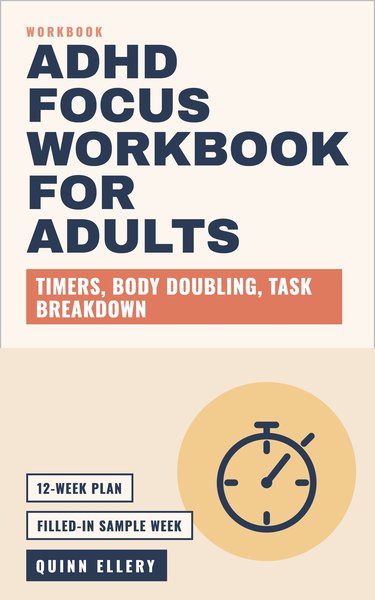
The companion workbook
ADHD Focus Workbook for Adults
by Quinn Ellery
A fill-in workbook built around the tools on this site: Pomodoro timer variants, body doubling, task breakdown into next physical actions, and time blindness tools that work with your brain, plus 12 weeks of undated focus planning pages.
Paperback on AmazonTime Blocking ADHD: Quick Answers
Short answers to common questions about time blocking and ADHD.
What is timeblocking for ADHD?
Timeblocking for ADHD means giving each task a fixed, short block on your calendar, with buffer time between blocks. It turns a vague to-do list into a visible plan, which helps with time blindness and task initiation.
Is there a time blocking template for ADHD?
A simple template: 25 to 45 minute blocks, a 10 minute buffer after each, one color per type of task, and your hardest task in your peak-energy window. Leave one open block each day for overflow.
What is block scheduling for ADHD?
Block scheduling groups similar tasks into one stretch of the day, such as email in one block and deep work in another. It reduces task switching, which is costly for ADHD brains.
🔗 Master Your Complete ADHD Time Management System
Continue building your ADHD productivity toolkit:
Frequently Asked Questions
Does time blocking work for ADHD?
It can, when the blocks are short and flexible. Rigid hour-by-hour plans tend to collapse after the first overrun, while a few color-coded blocks with buffers give structure without making one late task wreck the whole day.
How long should time blocks be for ADHD?
Many people start with 25 minute focus blocks, use 45 minutes for deep work at peak energy, 15 minutes for admin, and cap any stretch at about 90 minutes before a real break. Add a 5 to 15 minute buffer between different kinds of task.
What if I miss a time block?
Skip it and start the next one rather than trying to catch up. The buffers exist for this. At the end of the day, move anything unfinished to tomorrow's plan in one step.
What tools help with time blocking?
A visual timer, a paper planner with a time-blocked layout or a color-coded digital calendar, and reminders set a few minutes before each block starts.
Sources
- Cirillo F. The Pomodoro Technique (25 minute work intervals).
- CHADD, time management strategies for adults with ADHD.