⏰ ADHD Time Blindness: How Timers Save Your Productivity
Time Blindness Reality Check: If you have ADHD, you've probably said "I'll be there in 5 minutes" and arrived 20 minutes later, or estimated a task would take 30 minutes and it took 3 hours. You're not broken – your brain just processes time differently.
🧠 What is ADHD Time Blindness?
Time blindness is one of the most misunderstood aspects of ADHD. It's not about being lazy, irresponsible, or not caring about time. It's a neurological difference in how your brain processes temporal information.
🔬 The Science Behind Time Blindness
Research has linked ADHD to differences in brain systems involved in timing and time perception:
- Prefrontal Cortex: Executive function area that manages time awareness
- Cerebellum: Internal clock that tracks time passage
- Dopamine Pathways: Reward system that affects time perception
- Working Memory: Ability to hold time information in mind
What You Estimate
30 minutes
📝 "I'll write this report quickly"
What Actually Happens
3 hours
😵 "How did that take so long?!"
The four things that actually hold attention
Timers are half the answer. The other half is removing whatever keeps pulling you out of the block. These are the four that come up most, cheapest last.
 Sony WH-1000XM5 Noise Cancelling Headphones
The single biggest upgrade if noise is what breaks your focus. Everything else on this list is cheap because it is a nudge; this one removes the interruption entirely.
Check price on Amazon → Time Timer MOD, 60-Minute Visual Timer
Shows time as a shrinking disc rather than digits, which is the difference between knowing the time and feeling it.
Check price on Amazon → Rotating Flip Timer, 5/25/10/50
Flip it to start. No screen to unlock and no app to open, which removes the exact moment most sessions die.
Check price on Amazon → ADHD Daily Planner for Neurodivergent Adults
Time-blocked rather than open-ended, so the page itself does the estimating you would otherwise get wrong.
Check price on Amazon →As an Amazon Associate we earn from qualifying purchases, at no extra cost to you. Researched guidance, not medical advice.
🎭 The 7 Faces of ADHD Time Blindness
1. 🌀 The Time Estimation Trap
You consistently underestimate how long tasks will take, leading to:
- Chronic lateness despite your best intentions
- Overcommitting to projects and deadlines
- Feeling constantly behind and overwhelmed
- Frustration when "simple" tasks take forever
2. ⚡ The Hyperfocus Time Warp
When hyperfocused, time becomes completely irrelevant:
- Starting a "quick" task at 2 PM and looking up at 8 PM
- Forgetting to eat, drink, or use the bathroom
- Missing appointments and commitments
- Burnout from working too long without breaks
3. 🏃 The "Just One More Thing" Syndrome
Difficulty transitioning between activities:
- "I'll just send one more email" (sends 20)
- Getting stuck in preparation loops
- Always being "almost ready" to leave
- Procrastinating on starting new tasks
⚠️ Time Blindness is NOT:
- Being lazy or irresponsible
- Not caring about other people's time
- A character flaw you can "fix" with discipline
- Something you'll "grow out of"
It IS: A neurological difference that can be managed with the right tools and strategies.
⏲️ How Timers Transform ADHD Time Blindness
Timers work as external time-keeping systems that compensate for your brain's internal clock differences. Here's how they help:
🎯 1. Making Time Visible
Timers externalize time perception, making the invisible visible:
- Visual Progress: See time passing in real-time
- Concrete Boundaries: Clear start and stop points
- Reality Check: Accurate time awareness versus internal estimates
- Pattern Recognition: Learn how long tasks actually take
🧠 2. Reducing Cognitive Load
Stop using mental energy to track time:
- Outsourced Awareness: Timer handles time tracking
- Reduced Anxiety: No more constant time-checking
- Focus Freedom: All attention on the task
- Decision Relief: Timer decides when to stop
⚡ 3. Breaking Hyperfocus Cycles
Gentle interruptions prevent time warps:
- Hyperfocus Breaks: Alerts when it's time to pause
- Health Reminders: Prompts for water, food, movement
- Transition Cues: Prepare for activity changes
- Energy Management: Prevent burnout from overwork
🛠️ The ADHD Timer Toolkit: 6 Strategies That Work
Strategy 1: The Time Reality Check
Goal: Build accurate time estimation skills
- Before starting any task, estimate how long it will take
- Set a timer for your estimate
- When the timer goes off, note if you're done or not
- Track patterns over time to improve estimates
Strategy 2: The Hyperfocus Breaker
Goal: Prevent time warp episodes
- Set maximum work timers (90 minutes max)
- Use mandatory break alerts
- Include body check reminders (water, bathroom, food)
- Schedule transition warnings (15 minutes before meetings)
Strategy 3: The Transition Timer
Goal: Smooth activity changes
- Set "warning" timers 10 minutes before needing to stop
- Use "wrap-up" timers for finishing tasks
- Build in buffer time between activities
- Create leaving-the-house countdown timers
Strategy 4: The Accountability Timer
Goal: Stay on track with commitments
- Set timers for all appointments and deadlines
- Use multiple alerts (1 hour, 30 min, 15 min before)
- Include preparation time in your timer settings
- Share timer alerts with family/colleagues if helpful
Strategy 5: The Energy Management Timer
Goal: Work with your natural energy cycles
- Track when you're most/least focused during the day
- Schedule high-focus tasks during peak energy times
- Use shorter timers during low-energy periods
- Include mandatory rest periods after intense work
Strategy 6: The "Good Enough" Timer
Goal: Combat perfectionism that leads to time loss
- Set "good enough" time limits for perfectionist tasks
- When timer goes off, whatever you have is your answer
- Practice submitting "good enough" work on time
- Celebrate completing things within time limits
📱 Choosing the Right Timer for ADHD Time Blindness
Not all timers work equally well for ADHD time blindness. Here's what to look for:
🎨 Essential Visual Features
- Progress Visualization: See time remaining at a glance
- Color Changes: Visual cues for different time phases
- Large Display: Easy to see in peripheral vision
- Customizable Appearance: Adjust for your sensory needs
🔧 Critical Functionality
- Multiple Timers: Run several timers simultaneously
- Custom Time Intervals: Not just standard Pomodoro lengths
- Gentle Alerts: Notifications that don't startle
- Pause/Resume: Accommodate ADHD's variable needs
- Session Tracking: Learn your actual time patterns
🚨 Common Timer Mistakes (And How to Avoid Them)
❌ Mistake 1: Using Too Many Timers at Once
Problem: Timer overload creates more stress than help
Solution: Start with one timer type, master it, then add others
❌ Mistake 2: Setting Unrealistic Time Goals
Problem: Constantly "failing" timer goals creates shame
Solution: Start with generous time estimates and adjust down
❌ Mistake 3: Ignoring Timer Alerts
Problem: Timers become background noise you tune out
Solution: Use varied alert sounds and visual cues
❌ Mistake 4: All-or-Nothing Approach
Problem: Thinking you must timer everything perfectly
Solution: Progress over perfection – even partial success helps
📊 Measuring Your Time Blindness Improvement
Track these metrics to see how timers are helping your time blindness:
📈 Quantitative Measures
- Lateness Frequency: How often are you late to things?
- Time Estimation Accuracy: How close are your estimates to reality?
- Task Completion Rate: Finishing things in allocated time
- Hyperfocus Episodes: Frequency of 3+ hour uninterrupted work
🎯 Qualitative Improvements
- Stress Levels: Feeling more in control of time
- Relationship Quality: Less frustration from family/friends
- Work Performance: Meeting deadlines more consistently
- Self-Confidence: Trusting yourself with time commitments
🎯 Your 30-Day Time Blindness Challenge
Ready to transform your relationship with time? Follow this progressive plan:
📅 Week 1: Time Awareness Building
- Time estimate vs. reality for 5 daily tasks
- Use basic work timer (25 minutes) 3x per day
- Set one "leaving the house" countdown timer daily
- Track patterns in simple notebook
📅 Week 2: Hyperfocus Management
- Add maximum work timers (90 minutes)
- Implement mandatory break alerts
- Use transition warnings before meetings
- Practice "good enough" timers for perfectionist tasks
📅 Week 3: System Integration
- Coordinate multiple timers for complex days
- Add energy management timing strategies
- Involve family/colleagues in accountability
- Fine-tune alert styles and timing
📅 Week 4: Mastery & Optimization
- Analyze your timing data for patterns
- Adjust strategies based on what's working
- Share successes with ADHD community
- Plan long-term time management goals
Take Control of Your Time Today
Stop letting time blindness control your life. Start with our ADHD-friendly timer designed specifically for time awareness.
⏰ Start Your Time Awareness Journey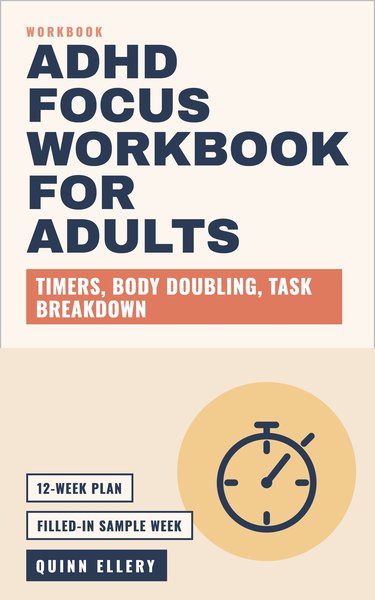
The companion workbook
ADHD Focus Workbook for Adults
by Quinn Ellery
A fill-in workbook built around the tools on this site: Pomodoro timer variants, body doubling, task breakdown into next physical actions, and time blindness tools that work with your brain, plus 12 weeks of undated focus planning pages.
Paperback on Amazon🔗 Master Your ADHD Time Management
Continue building your ADHD productivity toolkit: